November 19, 2009

How the social web has changed the journalist’s working day

Part 1;    Part 2;    Part 3;    Part 4;    Part 5;
How does a cutting edge, web-aware journalist’s average working day compare to how it was five years ago? More from Reed Business Information editorial development director Karl Schneider’s talk to journalism students at UCA Farnham.

Then

Research for a beat (eg: crime)

  • Calling contacts – police station, court
  • Looking on the web at rival publications
  • Confer with news editor to agree on the stories to write up
  • Then write up a story before lunch
  • Meet contact over lunch
  • More phoning and web browsing
  • Write up second story

Most of the stuff you do the audience never sees – it’s like an iceberg. 80% of it is research

Now

At Reed and national newspapers, journalists are working in a different way

  • Research and contacts are much the same
  • But journalists are communicating much more
  • Virtually all Reed journalists are using Twitter now
  • Virtually none were using it a year ago
  • It’s an essential part of the way they communicate with their audience

“As they come across pieces of information, if they think it would be useful for the audience to hear it, it’s trivially easy – you can do it in seconds. If they’ve got a bit of information, why hold on to it – why wait until they’ve got five more bits and constructed it into a  complete story? Why not publish the bit of information now?”
Karl Schneider

  • Audience gets it early
  • Gives opportunity for feedback

You’re much more likely to write something that taps into their needs.

CASE STUDY: FARMERS WEEKLY
When foot and mouth broke out again recently, the story broke at 10pm on a Friday night. Farmers Weekly had recently gone live with a user forum. The first post on the forum came from a farmer who lived near the farm where the outbreak happened.
Within 20 minutes Farmers Weekly journalist Isobel David was on the forum to confirm the story and provide more information plus links to the MAFF web site. Over the weekend the journalist posted whatever information she had on the site and collected reader feedback.
At one point the Government announced an exclusion zone, preventing the movement of cattle between affected farms. Isobel David reported this online. A reader posted a question about whether the rule excluded cattle under a year old, as had happened during the previous outbreak. The journalist went away, found out the answer and came back to respond.
A conversational journalism emerged, where the readers were giving information as well as taking it.

The journalist’s day now is a continuous conversation with the audience – with some lumps of more structured forms.
It looks like 20 times more work – but is actually a lot less.
Tweets take a couple of minutes extra to write and post.
A blog post is a bit like writing up research notes.
All the hard work of research behind the Tweets and blog posts and forum posts is the work a journalist would do anyway.
All you’re doing is exposing it to public view.

“Imagine you’ve got your reader on your shoulder – think about what they want to know. With the web you virtually have. You can ask them what they want to know; they can tell you what information they need.”
Karl Schneider

Part 1;    Part 2;    Part 3;    Part 4;    Part 5;

November 18, 2009

Cutbacks at Haymarket Brand Media

Just spotted at FleetStreetBlues (via Jon Slattery) – Haymarket closes Media Week.
Well, it’s going online only – but as FleetStreetBlues is so right to point out, the other two marketing titles that went online only this year have just been swallowed by Haymarket’s Brand Republic web portal. So they don’t really exist anymore.
As I wrote at the time, I was sorry enough to see Promotions & Incentives and Marketing Direct end their life in print. I spent many happy years at Haymarket Brand Media (though it wasn’t called that when I started), including Promotions & Incentives, Marketing Direct and the used-to-be-weekly, then-went-monthly, now-it’s-a-quarterly-supplement Revolution magazine.
I suspect Revolution doesn’t have long to live in print either. I’m actually surprised it’s kept going as long as it has. It’s a fine magazine – don’t get me wrong – but it makes no real sense to have a monthly physical magazine about the cutting edge of virtual web marketing. In fact, of all the titles, I would have expected it to go online only first.
I’m simultaneously very sorry about the closures and cutbacks – especially as I know many of the people still there – and also selfishly relieved to have moved on in the past couple of years to other areas. There’s no easy ride in media at the moment – but I’m glad I’m not relying on that division of Haymarket to pay my rent now…

November 18, 2009

Reed's Karl Schneider: "10 more years for print"

Part 1;    Part 2;    Part 3;    Part 4;    Part 5;
As promised yesterday, more from Karl Schneider’s talk to UCA journalism students. We’re moving into multimedia territory now – with a handy summary underneath the video in case you actually prefer, you know, reading.

Karl Schneider – editorial development director, Reed Business Information

Money

In brief:
On Rupert Murdoch’s plans to charge for web content:

“To a lot of journalists that’s very reassuring. But I’m very sceptical of the ability of mass publishing – for news as most of us understand news – to be charged for”
Karl Schneider

Key points:

  • More than 50% of Reed business Information’s revenue comes from the web
  • Newspapers aren’t viable financially if the only money they make is from sales
  • None of Reed’s magazines is viable from subscriptions or newsstand sales alone

We will make money in a number of ways:

  • Advertising will work (once the recession recedes)
  • Old-fashioned, untrackable brand advertising in print is “smoke and mirrors”
  • The interactivity and trackability of web advertising has much more potential to attract advertisers
  • We haven’t come up with the definitive models to do this
  • Don’t let the pursuit of the interactive advertising experience undermine your editorial content

How can we make this work?

  • Forget the old print model. Publishing is much more like being in a virtual space – think of it as a big room.
  • One analogy is with the world of events and exhibitions. You don’t just suggest an advertiser just sticks their ad on a wall. You let them interact with the audience.
  • But you don’t let them run across the stage when the keynote speaker is on. Instead, you create a parallel exhibition space that lets the advertiser interact with delegates and add value to the event.
  • We’re still only at the beginning of how to make this work.

Part 1;    Part 2;    Part 3;    Part 4;    Part 5;

November 17, 2009

Reed’s Karl Schneider: “What is online journalism?”

Part 1;    Part 2;    Part 3;    Part 4;    Part 5;
More from Karl Schneider’s talk to UCA Farnham journalism students (there’s no video for this section – stay tuned for the full multimedia experience in subsequent posts).
Karl_Schneider
How does web journalism differ from print? What are its defining characteristics?
Five key areas:

  1. Multimedia
  2. Links
  3. Global
  4. Measurable
  5. Interactive

Multimedia

Video is a key element. But it’s easy to get it wrong.
Broadcast is different from web

  • TV – you need to show moving images all the time
  • Web – you can use video only where it really adds value

Early mistakes:

  • Picking an area where video is used and then replicating it
    So, taking the traditional TV news/interview package and repeating it on the web is a no-no.

Instead:

  • Figure out what your site visitors might use video for.
    Reed’s Hairdressers Journal Interactive uses video guides to hairdressing techniques, for example.

Example: The 2004 tsunami had a lot of talking heads coverage after the event. But the content that got most visits online and had most impact was the user-generated video of the wave as it hit.
The model is not finished. Reed – and everyone else – is still trying to understand how video works best online.

  • How do you combine video with text, pictures and audio?
  • What’s the story?
  • Which elements work?

Links

The web is pervasive and distributed. This means you don’t have to show everything

“Cover what you do best, and link to the rest”
Jeff Jarvis – Buzzmachine

There’s no point in reworking press releases for your news in brief column – someone has already done it better and sooner. In effect, that old trainee reporter’s job will be transformed into a links round-up

  • A key part of the value of a good news blog is its links.
  • News sites act as a pathfinder for the reader.

Global

Web content and formats are global – implications

  • Go to where the audience is: YouTube, Flickr, Twitter etc
  • Think about scheduling your content for different time zones.

Measurable

  • Journalists need to get used to responding to numbers
  • Follow up stories that generate traffic quickly
  • But don’t be driven by stats – bring interpretation to web analytics

The web changes what and how people read…
…and quickly

How page views for Reed’s sites changed over a nine-month period

Page-views

  • Away from “traditional” journalism
  • Towards user generated content – forums, user videos etc

There’s a lot of room for more user content growth, because half of Reed’s sites don’t yet even have a user forum

“The vast majority of journalism in future will be done by amateurs”

Journalists’ role will be editing, filtering, packaging.

Interactivity

Fundamental change for the role of the journalist
In some ways takes the profession back to its roots – (there was news before there were newspapers)
Journalists develop a closer relationship with their audience

Print – a burden or an asset for your web strategy?

  • Pros: Print titles have an existing relationship with readers
  • Cons: Costly to produce; print publication schedule shapes editorial thinking

Sites such as Tech Crunch or The Register can run with whatever the web offers without worrying about the impact on print, and without the cost base of print.
Print may in future be a millstone around publishers’ necks.
How long has print got?

“Everything we do in paper will go online in 10 years”
Karl Schneider, Reed Business Information

But print has some life yet as long as it  makes use of its advantages:

  • High quality images (see recent double page spread images in The Guardian and the success of glossy magazines)
  • Big space (easy to scan, lots of content)
  • Portability (read it on the train)
  • Cultural legacy (old folk – the over-40s – like it)

Some legacy formats survive – others don’t:

  • Cinema coexists with TV
  • Horse and cart was superseded by automobiles

“Journalism is valuable, but we are arrogant to think we are the only people who can tell stories effectively”
Karl Schneider, Reed Business Information

You can sell news when it is:

  • Very niche and can affect financial decisions
  • Packaged in a way that makes it easy to use

Example: Reed packages human resources news and information into guidance notes to help HR professionals do their job more effectively and avoid employment litigation. It’s the same information freely available elsewhere, but packaged usefully
It doesn’t look like journalism, but it is gathered by journalists.
Next: “Can we make money from the web?”
Part 1;    Part 2;    Part 3;    Part 4;    Part 5;

November 16, 2009

Reed's Karl Schneider: "Most journalism will be amateur"

Part 1;    Part 2;    Part 3;    Part 4;    Part 5;
Key elements of future journalism, according to Karl Schneider, editorial director of Reed Business Information:

  • user-generated content – which will come to dominate
  • interaction via Twitter, forums and blogs
  • transparency and process journalism
  • multimedia content – eg video and interactive graphics

Karl-Scheider
This comes from this morning’s fascinating – and challenging – presentation to journalism students at UCA in Farnham.
I’m putting together a fuller summary – complete with grainy, shaky, poorly lit video! – for a post tomorrow. But one thing leaped out at me that’s worth stressing to journalism students.
If you want to work in tomorrow’s media, start being part of the media NOW.
It seems Reed is thinking about using participation in online media as a first-stage filter for job applicants.
So when you go for a job or placement interview at Reed, you may well be faced with questions such as “tell us about your blog”, and “tell us about your traffic”. No easy answer? Then the response may well be “thanks, but no thanks.”
I’ve said it myself, (though Karl Schneider said it better in his talk) – if you want to stand out in the media job market start a blog early and keep updating regularly.
It was one thing wanting to be a journalist in the olden days (ie about 15 years ago), with no real access to publishing if you weren’t actually working for a publisher. But publishing on the web is pretty much free these days, so there’s no excuse not to do it.
He likened it to approaching a record company for a record deal without being able to play an instrument. Saying “I was waiting to sign my contract before learning to play the guitar” is unthinkable. The same goes for journalism now.
Part 1;    Part 2;    Part 3;    Part 4;    Part 5;

November 15, 2009

Video: Clay Shirky on Twitter and the digital media revolution

This video from GRITtv featuring new media heavy-hitter Clay Shirky is worth checking out. Lots of Twitter boosting – which I know some journalists will like (though not all). And some insight into why and when such technology becomes important. Plus the whole “what is the future of journalism” meme.

Things I have learned:

  • Clay Shirky is so young. I pictured him as a 50-something, heavyweight academic.
  • He has no hair. At all. I didn’t even expect male-pattern baldness. I don’t know why.
  • Those ears. They practically have a life of their own. Respect.

The video is also worth watching for the intellectual content. Just by the way…
[HT: Greg Watts]

November 11, 2009

Publishers, Government – fix your broken links!

Having just installed the WordPress Broken Link Checker plug-in, I thought it would be a good idea to run it over the blog to see how disastrous my recent migration to a new web host has been.
So – how bad was it?
Actually, not so bad. Freelance Unbound has “975 unique URLs in 1,345 links”, apparently. How many were broken? A grand total of 17.
Most were mine – mainly from the migration to self-hosted WordPress, and mainly from my two longish series on surviving the media recession and keeping your blog going. These should now be fixed – but please feel free to let me know if any others go adrift.
One was a link to now defunct police blogger Nightjack – it seems appropriate to keep that in as a warning to other whistleblowers not to trust the mainstream media not to shaft your story for the sake of theirs.
But several were from sites that should know better. One linked to a Times opinion column, for example, that seems to have simply vanished from existence. It seems the paper has demoted Jane Shilling from a flagged-up columnist, and in the process lost some, though not all, of her columns. A bit sloppy.
Another was from a report on youth employment skills by government agency UKCES. I checked on a related government site, which also refers to the report, but that link is broken as well. That’s even more sloppy when you consider how often the government witters on about the importance of digital accessibility for citizenship.
Most annoying was the number of dead links to Haymarket Publishing stories. I’ve picked up on a few stories from Revolution magazine, as well as a piece from the Management Today editor’s blog. But after a few months the links had gone. Why is this?
The Revolution stories came from its email newsletter. I signed up for this for some reason a while ago, and it’s been interesting enough to keep subscribing and click through to regularly.
But if you link to a story that you’ve read via the newsletter, it tangles up a whole lot of extra newsletter reference code in the web address. Which then seems to expire. Thanks.
The Management Today site is even worse. I have written before about how Haymarket managed to lose the entire archive for Human Resources magazine, which is part of the Management Today group of magazines. Now it seems that some internal snafu has broken all the links for the editor’s blog.
Luckily, the stories are still there, and I finally managed to track down the one I needed again. But not by the site’s internal search engine. Oh no. That worked, yes. But for some reason the search results were linked to the old, outdated URL. (How is that even possible? Some kind of cache thing? Techie answers welcome.)
I understand that big sites are complicated, and links can get broken when you upgrade a CMS, say.
But links are the lifeblood of the web. It’s really important – especially if information is at the heart of your business – to make sure all your internal links keep working. It’s even more important for government agencies, which are starting to rely on the web to inform and educate citizens.
So – sorry to anyone who may have clicked on one of mine. I’m happy to spend an hour or so of an evening trying to fix them and will keep an eye on them in future.

November 10, 2009

Journalism vs academia

Following up a post on Paul Bradshaw’s Online Journalism Blog recently, I argued that journalism sits awkwardly in the higher education pantheon, and there are an awful of a lot of courses on the books – too many perhaps.
Steve Hill has weighed in to suggest, broadly, that journalism should indeed be the subject of academic study, and that we shouldn’t split hairs about defining our courses.

I just get lost with this debate about which courses are considered to be ‘academic’ and which are ‘practical/vocational’. Is medicine academic? Or is that practical? What about fine art? What about engineering?

It’s a good question – but crucially, in referring to medicine, fine art and engineering, it is not comparing like with like. A Bachelor of Medicine, Bachelor of Engineering or Bachelor of Science qualification is very different from a Bachelor of Arts. 
I did a BA in English Literature, and I remember having no more than 10 hours of tuition a week. It was probably more like five hours, certainly in the second and third year. I had some lectures, the odd seminar and tutorials. The rest was research. Because that’s what a BA is, really. 
In the same way that it wouldn’t work for, say, engineering, that doesn’t work for journalism. (Well, it doesn’t work for journalism practice – a culture and media studies-type research degree would be very different.) You need to put in a lot of hours and you need a lot of, well, practical education to be able to do it.
It’s best to learn to do journalism in a newsroom-type environment – being given assignments and then editorial feedback on what’s wrong (and right) and how students can improve. Unfortunately, a BA course doesn’t really have the resources to be able to do that.
This is compounded by the problem that school leavers nowadays don’t necessarily have a solid foundation in English language communications skills. But if you want to address this on a journalism course, you run into a problem.
Basic communications tuition – which is at the heart of journalism practice – will run into problems with course validation. There’s a good chance it won’t been seen as BA standard by whichever panel is approving your journalism course. 
So I guess my problem with journalism education isn’t so much about studying it at degree level as about it being lumped in with the BA qualification. 
Perhaps we should have a separate faculty for comms-type  education – with a BComms at the end of it. Or if we’re going to be really precious about it, perhaps we need a special Bachelor of Journalism qualification. 
Let’s face it – if students know they’ll be getting a BJ at the end of their studies, applications will soar…

November 9, 2009

Editorial integrity – the view from India

Times of IndiaIf you thought editorial integrity was being undermined in the UK, take a look at the Times of India
Indian journalism blogger Sans Serif has an interesting post on an investigation by finance journalist Sucheta Delal on the way the Times of India not only sells news coverage in the paper, but also uses that coverage to boost companies that it has bought shares in. This is achieved by using what are known as private treaties (PT). 
Quoting Delal, he says:

“Journalists are being designated as ‘champions’ for PT clients to tailor editorial coverage to enhance the value of these companies and TOI’s investment.”

A note of warning: watch out for the lack of a link to the source. I’ve been trying to track down the original report without success. Nonetheless, It’s a sobering piece. In comparison, it makes the Daily Mirror City Clickers share tip scandal look like very small beer. And they ended up going to jail…

November 9, 2009

Gardener’s World

From your gardening correspondent:
Tomatoes-grobagFaced with the prospect of utter media meltdown earlier this year, I thought I might end up having to forage for food around the local area, given that a lot of the work I was banking on had fallen off a cliff.
I did actually scrump some apples from the lane running behind my house, and gathered blackberries, Darling Buds style, from Farnham Park. But I soon realised that the biggest boost I could give my weekly food budget was to sidestep the supermarket when feeding my other half’s addiction to vine-grown tomatoes.
With that in mind, and inspired by the heroic efforts of my fellow blogger Soilman, I invested a few quid in a do-it-yourself grow-your-own-tomatoes kit from the local Homebase. “This will save a bit of money,” I thought, smugly. “We can enjoy fresh tomatoes off the vine all summer, and it will cost just pennies.”
Oh, how you all laugh. And rightly so.
I thought my early theoretical training on BBC Gardener’s World magazine would give me a solid grounding in all this. But frankly all it really achieved for me was the ability to spot typos in Latin names. In itself, not an unworthy talent. But not that useful in practical horticulture.
Let’s just run through all the horrific errors.

  1. Buying a kit from Homebase. I mean, really. Apart from the cheap nastiness of the black plastic propagator thing and the dubious quality of the compost, I had a packet of white label tomato seeds to plant that certainly weren’t Vittoria or Yellow Sungold (see how useful those days at the BBC were). I did wonder if I should ditch them and try some decent seeds from Mr Fothergill, but I was £7.50 in the hole already so I thought I’d save a bit of money.
  2. Planting the seedlings in early May – about a month later than recommended on the instructions. I don’t know how much of a problem this was, actually. Probably much less than all the other heinous errors.
  3. Leaving the propagator out in May’s torrential rain. Yeah. That was clever. And not checking it for a week. Unsurprisingly when I did finally look the soil was swimming in water. I did wonder why no little seedlings had appeared.
  4. Crowding my plants like Japanese commuters on the Tokyo metro. At last, many weeks after sowing the seeds, and some time after blotting most of the excess water from the propagator, I got around to planting out the seedlings in my brand new Gro-bag. How proud I was of my nurturing skills. What a shame I planted all of the dozens of little seedlings in the same bag. Yes. It was only many weeks later that I looked at the instructions again to see that I should have planted only three plants per Gro-bag.
  5. Not culling most of the plants when I had the chance. It’s just that I didn’t want any of those precious seedlings to go to waste. By the time I realised it might be a problem, the plants had achieved a thicket-like status that, I admit it, I was simply too scared to tackle.
  6. Not feeding the plants regularly. Not sure if this was good or bad, given that they didn’t actually have any room to grow in. But I’m sure my sadistic regime of feast and famine didn’t do them much good.
  7. Not staking up the plants. You may have noticed that my tomato plants are sprawling in indolent profusion all over the pathway. Forgetting that this was not a decorative border but a crop, I thought that looked rather charming and didn’t bother doing anything to support them at first. So they started sagging. And then pretty much collapsed.
  8. Not pinching out my plants. I actually still don’t really know what this is, or how to do it. But I could hear the despair in Soilman’s voice when he realised I hadn’t.
  9. TomatoesNot harvesting when I finally got some fruit. It was well into September before I started to see little green tomatoes growing on the vines. Thinking “Oh, they’ll ripen”, I just left them there. To rot.

Finally, after some sensible advice to gather the tomatoes and put them on a south-facing windowsill to ripen gently, I harvested everything I could and did just that. And waited to make a nice autumn salad with my lovely, glowing red, home-grown tomatoes.
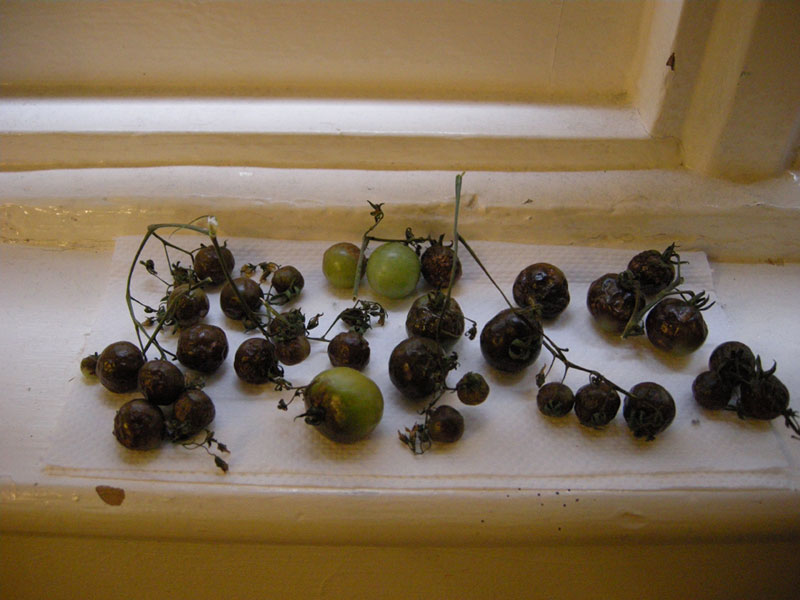
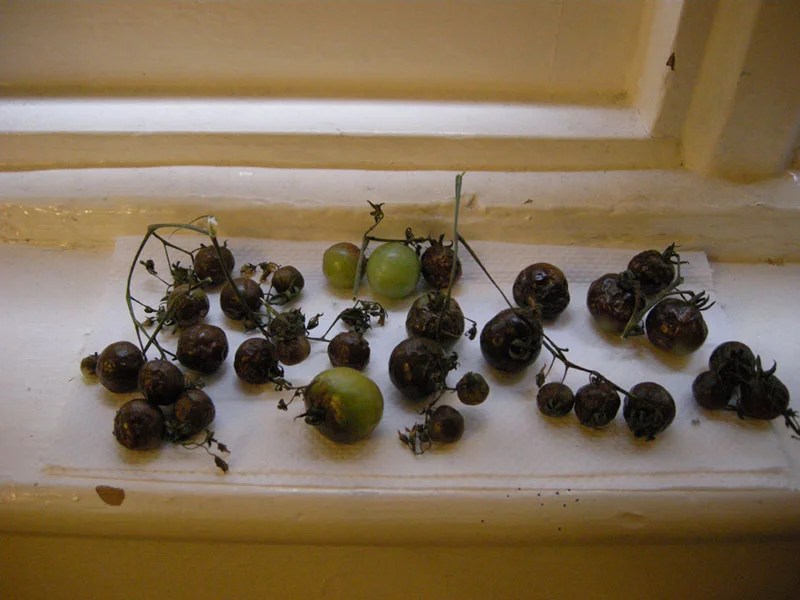
RottenIt was with some disappointment, then, that I found myself faced with this. It’s still a mystery to me how the couple of dozen tomatoes I managed to salvage went from firm and green to wizened and diseased with absolutely no period of ripeness in between. Any ideas from the allotment brigade gratefully received.
TomatoBut no! There was one lone tomato left. And after quickly quarantining it from the leprous mass it actually turned a healthy shade of red. I could retain some shred of self-respect through all this.
And so came the Evening of the Ceremonial Eating.
Gourmet
I could hardly make a salad with it, as it was so small it would have got lost among half a lettuce leaf and a bit of cucumber. It was more of an exquisite morsel – and should be presented as such, with a drizzle of oil and balsamic. A bit like this:
How was it? You may well ask. As tasteless as a forced own-brand supermarket Value tomato. But about 200 times more expensive.
Back to Waitrose. Sod the cost.